

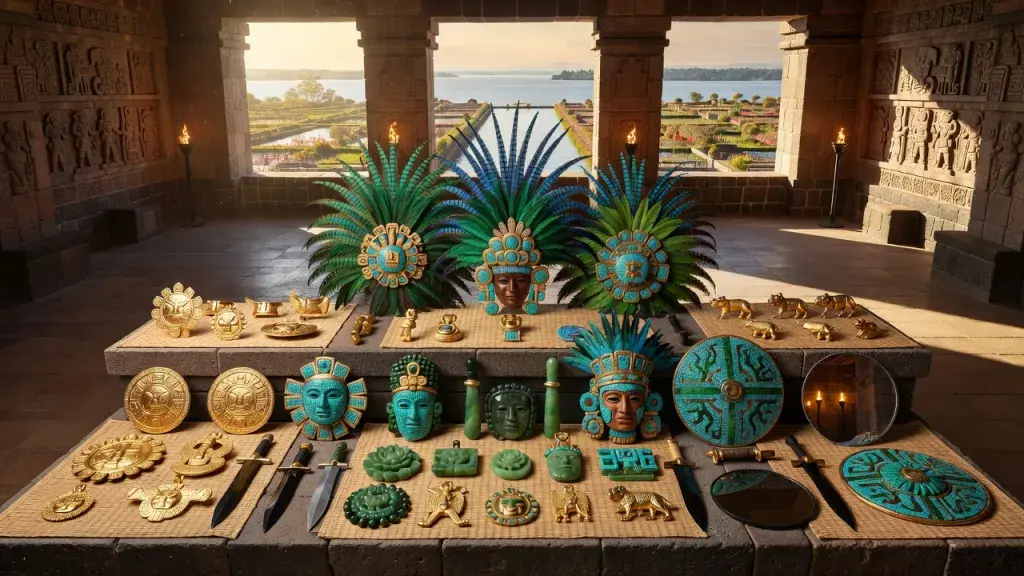
Spanish conquistadors melted down more Aztec gold objects than they preserved intact. That single fact explains why so much of what we know about Aztec metalwork comes from written accounts rather than surviving pieces - the empire's finest craftsmanship was, quite literally, liquidated for bullion within decades of contact. What remains today in museum vaults, private collections, and archaeological digs represents a fraction of what once existed, yet even that fraction tells a story of technical sophistication that rivaled anything produced in Europe at the time.
This guide walks through what survived, what was lost, and why the remaining Aztec treasures still command fascination five centuries later. We'll look at the materials the Aztecs valued most, the techniques they used to shape them, and the historical forces that determined which objects made it into the modern record. Along the way, for readers who enjoy exploring this history through interactive formats, the treasures of aztec demo offers a visual way to engage with the imagery and symbolism tied to this civilization without needing a museum ticket or a plane fare.
Understanding Aztec material culture means understanding a worldview - one where gold was not currency in the modern sense but a substance tied to the sun, divinity, and cosmic order. That distinction changes how we should interpret every artifact discussed here.
What Counts as an Aztec Treasure?
The term "treasure" gets used loosely, often lumping together anything old and valuable. In the Aztec context, it has a more specific meaning tied to material, craftsmanship, and ceremonial function.
Defining the Term in a Mesoamerican Context
Aztec treasures typically refer to objects made from precious or symbolically charged materials - gold, jade, turquoise, feathers, and obsidian - crafted for religious, political, or funerary purposes. Unlike European treasure hoards built around coinage and bullion, Aztec wealth was expressed through objects meant to be worn, displayed, or offered to deities. A feathered headdress or a jade pendant carried as much status value as a gold ornament, sometimes more.
Gold, Jade, and Feathers: A Different Value System
Jade held higher spiritual value than gold in Aztec cosmology, associated with water, fertility, and life itself. Gold, called teocuitlatl - "excrement of the gods" - was prized for its connection to the sun deity but was not the top of the value hierarchy the way it was in Europe. This inversion surprises many newcomers to the subject and is essential for correctly interpreting artifact significance.
Ceremonial Versus Everyday Objects
Most surviving pieces come from ceremonial or elite contexts - burial sites, temple offerings, tribute records - rather than daily life. Commoners used utilitarian tools of stone and wood, which rarely survive or attract attention, skewing the historical record toward the aristocracy and priesthood.
- Gold: solar symbolism, elite ornamentation, tribute payments
- Jade: life, water, high-status burial goods
- Turquoise: fire and royal association, often mosaic-inlaid
- Feathers (especially quetzal): rank, divine connection, ambassadorial gifts
Mesoamerican Artifacts: Categories and Craftsmanship
Aztec artisans did not work in isolation. They inherited and adapted techniques from earlier Mesoamerican cultures, including the Mixtec, whose goldsmiths were considered among the most skilled in the region.
Metalwork and Lost-Wax Casting
The lost-wax casting method allowed Aztec and Mixtec metalworkers to produce intricate gold pieces - pendants, labrets, and animal figures - with fine detail impossible through hammering alone. A wax model was coated in clay, heated so the wax drained out, then filled with molten gold. The technique demanded precise control of temperature and timing, and errors meant losing the material entirely.
Stone Carving: Obsidian, Jade, and Turquoise Mosaics
Obsidian, volcanic glass with edges sharper than surgical steel, was carved into ceremonial blades, mirrors, and figurines. Turquoise mosaics, applied to wooden or shell bases, decorated masks and shields used in ritual contexts. Jade carving required abrasive techniques since the stone's hardness resists most cutting tools - a slow, deliberate process reflecting the material's elevated status.
Featherwork: The Forgotten Art Form
Featherwork rarely survives centuries of humidity and handling, yet contemporary accounts describe it as among the most prized Aztec crafts. Quetzal, hummingbird, and macaw feathers were assembled into elaborate headdresses and shields, often for use as diplomatic gifts or royal regalia. The scarcity of surviving pieces makes each one disproportionately significant to modern researchers.
Codices and Their Role as Cultural Artifacts
Painted codices - folded bark-paper books - recorded tribute lists, religious calendars, and historical events. Few pre-conquest codices survived Spanish book-burning campaigns, but post-conquest copies and Spanish-commissioned reproductions preserve much of what we know about Aztec administration and belief systems today.
Aztec Gold: Symbolism, Sourcing, and the Spanish Conquest
No material generates more myth and misunderstanding than Aztec gold. Its cultural meaning and its role in the empire's downfall deserve separate treatment.
Why Gold Mattered to the Aztecs
Gold's association with the sun god Tonatiuh gave it religious weight beyond its rarity. It adorned temple idols, royal regalia, and tribute items sent from conquered provinces to Tenochtitlan. Tribute records, preserved in codices like the Matrícula de Tributos, list gold dust, ornaments, and jewelry flowing into the capital from across the empire.
Mining and Working Techniques
The Aztecs did not mine gold extensively themselves but received it primarily through tribute from regions with alluvial gold deposits, particularly along rivers in Oaxaca and Guerrero. Goldsmiths, often drawing on Mixtec expertise, transformed raw gold into finished ornaments using casting, hammering, and gilding techniques.
The Melting Point: How Conquest Destroyed the Record
When Hernán Cortés and his forces seized Tenochtitlan, they prioritized gold's monetary value over its artistic or cultural significance. Ships loaded with melted ingots sent to Spain represent an incalculable cultural loss - pieces that took skilled artisans months to produce were reduced to bars in hours. This single historical decision explains why so few gold Aztec artifacts survive compared to jade or stone pieces.
Famous Gold Artifacts That Survived
- The Mixtec gold pieces from Tomb 7 at Monte Albán, technically pre-Aztec but reflecting shared regional craftsmanship
- Small gold labrets and pendants housed in European and Mexican museum collections
- Gilded ornaments recovered from offerings at the Templo Mayor excavation in Mexico City
Ancient Aztec History: The World Behind the Objects
Artifacts only make sense within their historical framework. Understanding the empire's rise, structure, and fall clarifies why certain objects were made, who used them, and why so few remain.
The Rise of Tenochtitlan
Founded around 1325 on a lake island, Tenochtitlan grew from a marginal settlement into the political center of a tribute empire spanning central Mexico within roughly two centuries. Its location on Lake Texcoco, connected by causeways and canals, shaped both its defense strategy and its trade networks.
Political Structure and the Tribute System
The Aztec state was not a single unified empire in the modern sense but a network of city-states bound by tribute obligations to the Triple Alliance of Tenochtitlan, Texcoco, and Tlacopan. Conquered regions paid in goods - cotton, cacao, feathers, gold - rather than direct governance, which explains the diversity of materials found in Aztec elite contexts.
Religion, Ritual, and Object Use
Religious practice permeated daily and political life, and objects served as intermediaries between human and divine realms. Temple offerings buried beneath the Templo Mayor included jade figures, shell ornaments, and sacrificial implements, deliberately placed as gifts to deities rather than for display.
Spanish Contact and Cultural Disruption
Cortés arrived in 1519, and within two years the empire had collapsed under a combination of military conflict, disease, and internal political fracture among rival city-states. The speed of collapse meant that much material culture, including irreplaceable gold and featherwork, was lost, converted to bullion, or scattered before it could be documented.
Where to See Aztec Treasures Today
Physical access to authentic Aztec artifacts is limited and concentrated in specific institutions, though digital alternatives have expanded in recent years.
Major Museum Collections
The National Museum of Anthropology in Mexico City holds the largest collection of Aztec artifacts globally, including the Aztec Sun Stone. The British Museum and Museum of the Americas in Madrid also hold significant pieces, a legacy of colonial-era acquisition.
Archaeological Sites Worth Visiting
The Templo Mayor site in Mexico City's historic center remains the most direct connection to Aztec material culture, with an on-site museum displaying items recovered during ongoing excavation. Teotihuacan, though built by an earlier civilization, was revered and actively used by the Aztecs and offers insight into the broader Mesoamerican context they inherited.
Digital and Interactive Alternatives
For those unable to travel, digital reconstructions and thematic experiences provide accessible entry points into Aztec visual culture. These formats won't replace firsthand study of Mesoamerican artifacts, but they lower the barrier for casual learners curious about the symbolism and aesthetics tied to this history.
Frequently Asked Questions
Was all Aztec gold melted down by the Spanish?
Not all of it, but the overwhelming majority was. Surviving gold pieces largely come from burial offerings or tribute-related contexts that were buried or hidden before conquest, rather than objects that passed directly through Spanish hands.
What is the most famous Aztec artifact?
The Aztec Sun Stone, a carved basalt disc depicting cosmological symbolism, is the most recognized artifact and is displayed at the National Museum of Anthropology in Mexico City. It is often mistaken for a calendar, though its exact function remains debated among researchers.
Did the Aztecs value gold more than jade?
No. Jade generally held higher spiritual and symbolic value in Aztec culture, associated with life and water, while gold was tied to solar symbolism and elite status. Value in Aztec society was not purely about material rarity but about religious and cosmological association.
How were Mesoamerican artifacts preserved despite the conquest?
Many surviving artifacts were buried as temple offerings before the conquest and were only rediscovered through modern archaeological excavation, such as at the Templo Mayor. Others survived because they were made of durable stone materials like jade and obsidian, which held little monetary interest to Spanish colonizers.
Can I see authentic Aztec treasures outside Mexico?
Yes. Institutions such as the British Museum in London and the Museum of the Americas in Madrid hold Aztec and broader Mesoamerican collections, largely acquired during the colonial period. Availability and scope vary, so checking current exhibits before visiting is advisable.
What materials besides gold were considered treasures?
Jade, turquoise, obsidian, and quetzal feathers were all considered highly valuable, often exceeding gold in ceremonial or symbolic importance. Featherwork in particular was prized for royal regalia and diplomatic gifts, though it rarely survives due to material fragility.


